Stay Updated
Join our mailing list to stay informed on how we're creating pathways to opportunity.
Where you grow up matters. Decades of research show that neighborhoods shape children’s chances in life, from education and health to income and long-term stability. Yet in many American cities, including Baltimore, low-income Black families with children are still far more likely to live in neighborhoods with fewer resources, struggling schools, and limited opportunity.
A new study by economist Dionissi Aliprantis and sociologist Stefanie DeLuca, Unlocking Opportunity – The Remarkable Success of the Baltimore Regional Housing Partnership, takes a deep look at how the Baltimore Regional Housing Partnerships’ housing mobility program is breaking this pattern. The findings are striking and offer important lessons for cities across the country.
The Baltimore Housing Mobility Program (BHMP) is administered by the Baltimore Regional Housing Partnership to help low-income families, most of whom are Black and originally live in highly racially and economically segregated Baltimore City neighborhoods, use housing vouchers coupled with support services to move to areas with stronger schools, lower poverty, and more opportunity.
Participants in the program can search across Baltimore City and the five surrounding counties, ensuring access to the greatest number of opportunity neighborhoods in the region. The program adapts the traditional HCV program to optimize client successful lease-up in opportunity neighborhoods through extended search times, setting payment standards per census tract, and providing unit referrals at voucher issuance. The program also provides hands-on support, including housing search assistance, counseling before and after the move, and active outreach to landlords.
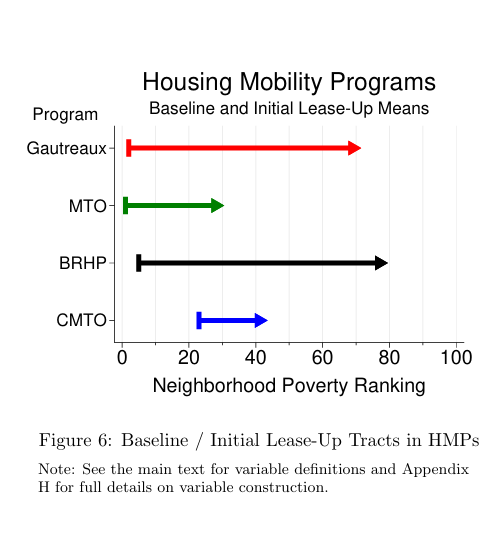
The results show that the Baltimore Housing Mobility Program is working exceptionally well. BRHP delivers the largest neighborhood-quality gains among housing mobility programs studied. Families commonly move from ~30% to ~5% neighborhood poverty, a shift from the 5th to the 77th percentile of the national neighborhood-poverty ranking, and within Maryland into some of the highest scoring socioeconomic status (SES) neighborhoods.
BRHP disrupts entrenched racial and income sorting. In contrast to standard housing patterns in Baltimore and nationally, BRHP households do not follow predictable sorting by race or income. Participants live in neighborhoods with socioeconomic status on par with the highest-income Black households in the region and in neighborhoods that are more racially integrated than those of Black households at any income level.
Access to higher performing schools rises dramatically. On average, BRHP participants live in areas zoned for elementary schools performing ~40 percentile points higher than those zoned to low-income Black families in Baltimore City.
Regional design is the key driver. 66-70% of BRHP’s participants accessing high SES-neighborhoods- over comparable groups is explained by cross-county moves that allow access to the region’s full range of opportunity census tracts.

Why this matters: Historically, Housing Choice Voucher (HCV) households tend to lease in neighborhoods only modestly higher in opportunity than other poor households, and often near lower performing schools. BRHP breaks that pattern at scale: families lease in neighborhoods ranked substantially higher in socioeconomic status (SES) and access markedly higher performing schools, with gains that persist across subsequent moves. This approach helps families realize the original intention of the Housing Choice Voucher program created 52 years ago – expanding residential choice regardless of economic means.
What BRHP achieves
–In 2022, BRHP participants lived in tracts with Neighborhood SES ≈ 60 versus 23 for Black non-BRHP HCV households in Baltimore City (+37 points), and versus 15 for poor Black Baltimore City residents (+45 points).
–Assigned elementary schools for BRHP families are at the 49th percentile in performance statewide (ELA + Math average on the Maryland School Report Card), compared with the 12th percentile (Black HCV Baltimore City) and 10th percentile (poor Black Baltimore City).
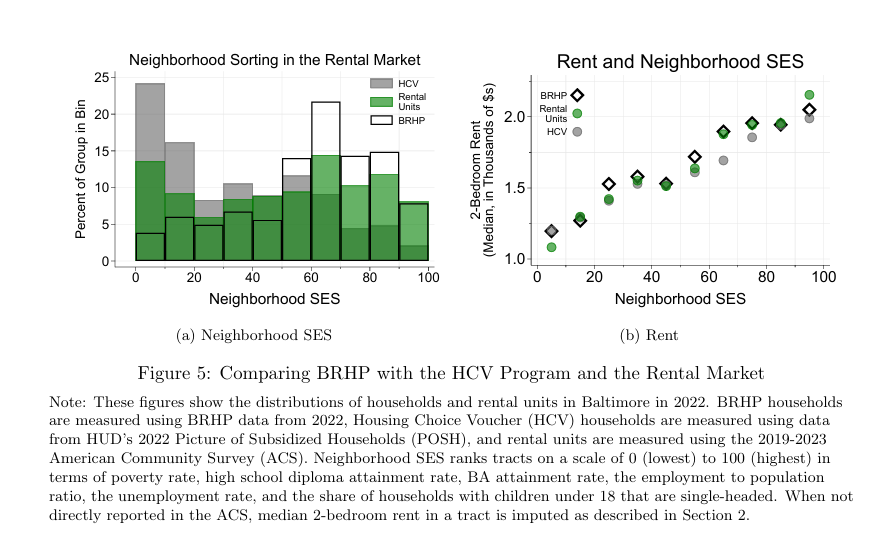
–Relative to the broader rental market, BRHP families move into higher-SES neighborhoods (median SES 62 for BRHP participants vs 54 for all rental units and 33 for HCV households in Baltimore City). Rents paid are broadly in line with market rents at higher SES levels, indicating access without overpayment.
Why the regional model matters
Opportunity rental supply is concentrated outside Baltimore City; only about one-fifth of rental units in “opportunity neighborhoods” (top SES deciles) are in the city itself. The regional footprint lets families reach all opportunity tracts and higher-performing school districts.
Oaxaca-Blinder decompositions show two-thirds of BRHP’s neighborhood-SES gains come from between-county mobility, not just better sorting within a single county.
Breaking typical segregation patterns
BRHP households live in neighborhoods with SES comparable to those of the highest-income Black households in the region, despite much lower household incomes, evidence that the program disrupts standard sorting by race and income.
Neighborhoods that BRHP families choose are more racially integrated than those of Black households at any income level (mean BRHP tract ≈ 34% Black, lower than the share in neighborhoods of the region’s highest- and lowest-income Black households).
Durability over time
Gains persist: second (and later) moves remain in high-SES tracts. Households initially moving into lower-Black-share tracts are slower to leave and tend to choose similarly composed neighborhoods when they do move.
A hopeful takeaway
Residential segregation and concentrated poverty did not happen by accident and will not disappear overnight. This research offers rare and convincing evidence that well-designed policy intervention can make a material difference.
The Baltimore Regional Housing Partnership shows that expanding choice across neighborhoods, across jurisdictions, and across lines of race and income can unlock opportunity where it matters most: in the everyday lives of families and children.
This research will continue with a second phase further investigating the long-term outcomes for BHMP families living in opportunity areas.
By Emily Hovermale, External Affairs Director, BRHP